Joining the long list of technological promises that don't quite make the grade such as "Nuclear: too cheap to meter" and the oxymoron "3G Broadband" is quantum cryptography. Quantum hackers known as 'quackers' have a few ways in to breach quantum cryptography already, and this trend will continue.
Quantum cryptograpy is meant to be a system that can detect interception of the photons comprising a communication by a hacker flawlessly. It is meant to be perfect, and not just a step foward. It is already crackable, though, albeit through high faluted means.
In quantum messages, the message is sent through traditional means, but the encryption key (called a 'one time pad' or OTP) is transmitted using the quantum states of individual photons. The theory is that you cannot read a bit of the OTP without changing its quantum state, so therefore any hack attack will be noticed, and a new key can be created to replace the compromised key. Quantum crypotgraphers encode keys rather than the message because transmission rates are low (currently a few kbps over 20km), though this will improve with faster detectors.
Quackers exploit several weaknesses here, mainly focused on the quantum/silicon interface.
Problem: practically producing single photons is challenging. If there's more then one photon encoding a bit, then the quacker can read one, and the receiver reads another that has not been disturbed. Therefore the receiver will not detect the intrusion.
Solution: better lasers that can accurately issue single photons. Needs time to make this happen.
Problem: saturating the detector with strong light allows control without detection of the signals
Solution: requires physical access to detector, and more advanced detectors could be make without this flaw
Problem: any connection to a public network allows traditional hacking
Solution: restrict quantum crptography to closed networks, but this limits its usability for the general world
Problem: quantum bits get interpreted into electrons so they can be used. This happens sometime before the user's computer/server, so is necessarily hackable by traditional means.
The point here is not that quantum cryptography isn't very secure, because it's by far the best there is. My point is that it is not flawless. Quantum cryptography is an additional line of defence, but sadly not flawless. It's not a 'quantum leap' in security (to use a pun), just a (very good) forward step in the cat-and-mouse game between networks and hackers.
Saturday, 25 October 2008


Sunday, 19 October 2008
Ten Revolutions to Come
The future will be very different in 20 years time. These are my predictions of the most important changes in the computer industry about live in 20 years. This entire blog is devoted to tracking and providing evidence for these 10 beliefs.
1. The Mobile Phone will not be a Device
Since 'bricks' were first issued to yuppies in the 80s, mobile phones have been electronic devices. They have their own buttons, battery, screen and audio I/O. In 2020, mobile devices will be integrated into our clothes and bodies; and will be a mashup of technologies in our clothes and bodies.
(Of course, my Dad will be 88 in 2020, and he'll probably still have a GPRS-based clamshell).
Key topics:
All devices, except those we plug in the wall, are based on batteries. This is the biggest drag on development right now, and manufacturer's responses have been to increase the effectiveness of batteries by increasing lifetime and decreasing drain. This is unsustainable, and equivalent to teaching telegraph operators to tap quicker.
By 2020, we'll see the battery become a back-up only component, with the power needed for digital communications on the move coming from other sources; either for the communications themselves, or as a mechanism to charge up far more frequently than we discharge.
Key Topics:
Placing a brick (no matter how sleek) to the ear, or furiously typing on a keypad, or writing with a pen, is old fashioned and has to go. Instead, the most normal means of communication will be silent and based on thought, or mental articulation; or automatic.
Talking will still happen, just as people fly to see each other in business meetings; but will be a pleasurable luxary, not a necessity.
Although in early stages, the ability for the brain to communicate with a computer without fingers or voice is hapenning. This will get much better.
Key topics:
4. We won't need passwords
The Network will simply know who we are, so there'll be no need to verify our identify. It will be like picking up my kids from school -- they know me; that's as secure as they, or I, need.
Key topics:
5. Computers will know everything about us, and we'll be happy about it
The privacy lobbyists hate Google for perpetually gathering any useless piece of information about us and using it target advertising at us. This is not going to change and increasingly companies (and governments) are getting more and more infromation about us and storing it. The privacy forums will eventually have to give up, every last nuance of what we do will live in a database somewhere, and algorithms will continue to evolve to make sense of it all.
Key topics:
"Silicon chip inside her head is set to overload". We've always assumed that silicon computers need to be near us, but this is disappearing. Google docs, remote desktop, Zoho, and other online tools will do the clever stuff, and we will move towards the dumb terminal client.
Key topics:
How long has it been that we type with our fingers and slide our fingers on a trackpad, or worse scratch a hemisphere on the table? We'll have better interfaces with our computers than this which will be more intuitive and faster for our main locations.
Key topics:
My most accurate forecast ever as an analyst was an IP traffic forecast in 2001. It was a hockey stick. My belief here is that applications grow to fill the bandwidth made available, and bandwidth follows applications. As we get more bandwidth, applications will evolve to use more. The net result is that we will never have enough bandwidth.
Key topics:
9. We'll pay more
The market for communication will increase in revenue because we (as consumers and businesses) will pay for the value it provides. As in an earlier blog today, I show that Maslow's Hierarchy of Needs puts communications at the heart of human needs, and the easier it becomes, the more we'll depend on it, and the more it will have value to us.
As digital communications gets better, we'll be prepared to invest a greater proportion of our investments into it, as measured by the industry revenue as percent of GDP.
Key topics:
The distinction between the real world and virtual worlds will change. Sitting permanently in a darkened bedroom, any netizen geek will tell you that they are a global jet setter.
This prediction is looking at attitudes to the virtual world, and the technologies that allow it to look and feel more and more like the real world.
Key topics:
1. The Mobile Phone will not be a Device
Since 'bricks' were first issued to yuppies in the 80s, mobile phones have been electronic devices. They have their own buttons, battery, screen and audio I/O. In 2020, mobile devices will be integrated into our clothes and bodies; and will be a mashup of technologies in our clothes and bodies.
(Of course, my Dad will be 88 in 2020, and he'll probably still have a GPRS-based clamshell).
Key topics:
- bio-computer interfaces
- PAN protocols
- alternatives to silicon-based computing
All devices, except those we plug in the wall, are based on batteries. This is the biggest drag on development right now, and manufacturer's responses have been to increase the effectiveness of batteries by increasing lifetime and decreasing drain. This is unsustainable, and equivalent to teaching telegraph operators to tap quicker.
By 2020, we'll see the battery become a back-up only component, with the power needed for digital communications on the move coming from other sources; either for the communications themselves, or as a mechanism to charge up far more frequently than we discharge.
Key Topics:
- battery technologies
- remote power
Placing a brick (no matter how sleek) to the ear, or furiously typing on a keypad, or writing with a pen, is old fashioned and has to go. Instead, the most normal means of communication will be silent and based on thought, or mental articulation; or automatic.
Talking will still happen, just as people fly to see each other in business meetings; but will be a pleasurable luxary, not a necessity.
Although in early stages, the ability for the brain to communicate with a computer without fingers or voice is hapenning. This will get much better.
Key topics:
- bio-computer interfaces especially brain-computer interfaces
4. We won't need passwords
The Network will simply know who we are, so there'll be no need to verify our identify. It will be like picking up my kids from school -- they know me; that's as secure as they, or I, need.
Key topics:
- Identity
5. Computers will know everything about us, and we'll be happy about it
The privacy lobbyists hate Google for perpetually gathering any useless piece of information about us and using it target advertising at us. This is not going to change and increasingly companies (and governments) are getting more and more infromation about us and storing it. The privacy forums will eventually have to give up, every last nuance of what we do will live in a database somewhere, and algorithms will continue to evolve to make sense of it all.
Key topics:
- data storage capabilities
- data manipulation and algorithms of unstructured forms
- privacy legislation
- benefits of an omniscient network
"Silicon chip inside her head is set to overload". We've always assumed that silicon computers need to be near us, but this is disappearing. Google docs, remote desktop, Zoho, and other online tools will do the clever stuff, and we will move towards the dumb terminal client.
Key topics:
- SaaS
- Grid computing
- Remote software
How long has it been that we type with our fingers and slide our fingers on a trackpad, or worse scratch a hemisphere on the table? We'll have better interfaces with our computers than this which will be more intuitive and faster for our main locations.
Key topics:
- Novel interfaces and IO devices
- Haptics, gentures
- Video recognition
My most accurate forecast ever as an analyst was an IP traffic forecast in 2001. It was a hockey stick. My belief here is that applications grow to fill the bandwidth made available, and bandwidth follows applications. As we get more bandwidth, applications will evolve to use more. The net result is that we will never have enough bandwidth.
Key topics:
- bandwidth hungry applications
- what would we do with 1Tbps each, anywhere?
9. We'll pay more
The market for communication will increase in revenue because we (as consumers and businesses) will pay for the value it provides. As in an earlier blog today, I show that Maslow's Hierarchy of Needs puts communications at the heart of human needs, and the easier it becomes, the more we'll depend on it, and the more it will have value to us.
As digital communications gets better, we'll be prepared to invest a greater proportion of our investments into it, as measured by the industry revenue as percent of GDP.
Key topics:
- Market evidence of more money
- What will cause the next step jump in peoples' desire to pay money?
The distinction between the real world and virtual worlds will change. Sitting permanently in a darkened bedroom, any netizen geek will tell you that they are a global jet setter.
This prediction is looking at attitudes to the virtual world, and the technologies that allow it to look and feel more and more like the real world.
Key topics:
- virtual worlds' acceptance on society
- making the virtual experience more real
Why do we communicate?
65 years ago, Abraham Maslow wrote his paper on human needs, and it's standard text in most economics courses. He elegantly ranked human experience on 4 levels: Physiological, Safety, Love/Belonging, Esteem and Self-Actualization.

He wrote, and I agree (at least as far as gross generalizations go), that humans can only be motivated on a level if all other levels below are met.
The human desire to communicate is pervasive across all categories above Physiological, and consequently we're all keen to have communications links to others.
This is why, from the days of the telegraph, we are increasingly investing our resources on communicating, and this is increasing. In 2000, the telecom industry was worth about 2.5% of global GDP, now it's 3.5%, largely due to mobile phones which have tapped into the "safely" tab of Maslow's Hierarchy of Needs as well as enhanced all the others.
We (in developing countries) are now in a position where we assume remote communication capabilities, and we physically distribute ourselves with this assumption in mind. It's not so much "where do you live?", but "how reliable is your broadband/mobile?"
As the world retracts into what I believe will be an immensely protracted recession (compared to the 90's and 00's), our desire to communicate will not be affected. It's a basic need and can't now change.
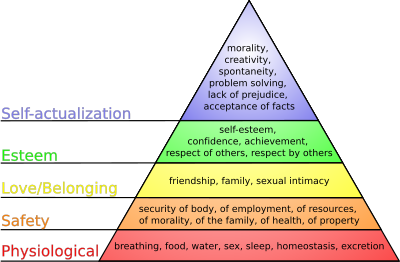
He wrote, and I agree (at least as far as gross generalizations go), that humans can only be motivated on a level if all other levels below are met.
The human desire to communicate is pervasive across all categories above Physiological, and consequently we're all keen to have communications links to others.
This is why, from the days of the telegraph, we are increasingly investing our resources on communicating, and this is increasing. In 2000, the telecom industry was worth about 2.5% of global GDP, now it's 3.5%, largely due to mobile phones which have tapped into the "safely" tab of Maslow's Hierarchy of Needs as well as enhanced all the others.
We (in developing countries) are now in a position where we assume remote communication capabilities, and we physically distribute ourselves with this assumption in mind. It's not so much "where do you live?", but "how reliable is your broadband/mobile?"
As the world retracts into what I believe will be an immensely protracted recession (compared to the 90's and 00's), our desire to communicate will not be affected. It's a basic need and can't now change.
What is LongView?
The world seems to have lots of comments about the future telecom markets, and there's a well established market for market research. This blog is designed to discuss the 10-15 year future for telecom.
We don't know who the players will be, nor do I really care (not in this blog anyway). What I care about is really understanding what our experience of communications will be in 2020, and trying to document what steps scientists are taking to get us there.
Is this Arthur C Clarke territory? Yes. But I want to focus on the tangible scientific research which is getting us there. No doubt, though, I will get distracted into the speculative world of "what would be lovely".
Note on personal associations: I am employed by Yankee Group, the most foward looking of the Industry Analysts in telecoms. However, this is a personal blog. Click here for YG's official blog.
We don't know who the players will be, nor do I really care (not in this blog anyway). What I care about is really understanding what our experience of communications will be in 2020, and trying to document what steps scientists are taking to get us there.
Is this Arthur C Clarke territory? Yes. But I want to focus on the tangible scientific research which is getting us there. No doubt, though, I will get distracted into the speculative world of "what would be lovely".
Note on personal associations: I am employed by Yankee Group, the most foward looking of the Industry Analysts in telecoms. However, this is a personal blog. Click here for YG's official blog.
Subscribe to:
Comments (Atom)